Showing posts with label education. Show all posts

Tuesday, April 01, 2008

AAM Digital Museum Webinar 3: Online Learning and Education

Really looking forward to this webinar. Should be interesting. I forgot my giant over-the-ear headphones at home, so will be using my earbuds.

Yeouch! My earbuds apparently have some kind of higher preset volume than the other headphones. Am frantically messing with volume settings. No luck.

After notes: I like these sessions, but it begins to feel very frantic when I'm trying to listen, read a slide, a chat box, and liveblog it. I wouldn't take anything away, but it's a lot of multitasking at one time. My brain is full.

Notes below the jump


NOTES:
Question 1: How is online learning implemented by museums?
Deb Howes, MOMA: Both museums and the internet focus on Information and Visitors. The internet, however, attracts a more diverse audience than museums can hope to manage. about 50% of participants have twice as many web visitors than museum visitors (but what def. are they using for web visitor?). Web offers formal and informal learning opportunities. Formal roughly equates to passive: reading, viewing, etc. Informal learning roughly equates to active: searching for info? Not sure about this assertion. blog.mode: addressing Fashion.

Victoria and Allegra: Teens as an audience. Do you offer teen programming? Well, not unless you count interns under 20, but that's hardly what they're asking. Hey now! Teens are using the intarwebs, so museums are working with that to get the teens involved. Museum teen sites? Or do we mean teen pages? Walker site has a business side and a play side (the mullet model of websites!)

David Schaller: Games v Game like activities. What is a game? engagement, conflict, rules and outcome. 2 kinds of games: Intrinsic (game play leads to information (fish ecosystem game) game play has constraints of environment (Colonial Williamsburg). Mold gameplay around content. Content centric) and Extrinsic (tic tac toe, memory. Game play not effected by extras (squid instead of Os)) content. Intrinsic is probably a more powerful gameplay experience.

Question/comments: How much of a role does Ed. Dept play in website? MOMA had much involvement. Do teens actually use these specialized sites independently or are directed by teachers? Mix of both. Site marketed to teachers. Teens stumble upon site outside of school at least somewhat.

Question 2: Which online learning environments work for which Audiences?
Allegra and Victoria: MOMA. How teens use the internet. as of 1/2007 55% of 12-17 yos use social network site. 64% create content (12/2007). Girls post more networking and photos; boys more likely to do videos. Teen friendly outreach content, social networking. Science Buzz offers model for online community exchange. Also RedShift Now. Online Video: on MoMA's site, on YouTube. Expansion beyond one site makes it easier for individuals searching for specific content from non-specific sites. Red Studio teen podcast most popular download from MoMA.

Susan Edwards: Getty trust. Who plays digital games? Demographics. Avg age: 33, 1/4 over 50. 38% are women. 81% of teens play computer games. Lifestyle: over half of parents think games are positive. 93% read books/newspapers regularly. 62% attend cultural events, 50% do creative activities.

David: Who play extrinsic content games? has low/no learning curve, low time commitment. Games can introduce collections/promote institution. Who plays intrinsic games? more involved, immersive, meaningful actions, problem solving, can assume new roles/identities, safe environment for exploring/risk-taking. Allow for recreation of rules of nature/society in a contextualized world. More than kids play these games.

Deb: Which online approach works for adults? Asynchronous occurs without a teacher (websurfing). Make sure that your content is well tagged, accessible, and easy to find much information - similar things, but well organized. Synchronous=a class with teachers/learners. Can do in a collab. space/virtual worlds/IM. Simulcasting type things. Combination can be effective, like in a teacher workshop. plan, use high quality, respond to user needs.

Questions/comments: How can you show that your tools/games/experiences help learning? It's hard to evaluate online. could incorporate into game through levels. or just use return stats to indicate success.

Question 3: What are good strategies for beginning and sustaining online learning in museums?

Allegra and Victoria: Teen project, consider the following: Audience, objects, scale, branding/marketing. Teens are attracted to authenticity: No phonies! Resources and scale: free-blogs, wikis, myspace/facebook, youtube, but has costs in terms of staffing, production, and marketing. Build in evaluation.

Susan: Keeping the Games Alive: Maintenance and scalability. Goals/budget/promotion step. Attracting and sustaining learning. scaffolding - keep content fresh, provide opportunities. "Whyville" like 2nd life for kids. Partner to develop. Foster online community: boards, blogs, polls leads to promotion/engagement and feedback in one.

Deb: How to get started and sustain the momentum? Know your free tools! (cough*google*cough). Add online components to existing programs. Keep it going through partnered outreach. Have on-site support. Create lifelong museum learning continuum.

Q&A mode: Oh noes! Can we trust the teens? Moderated posting.
Trying to recreate the physical space is not the greatest method - online is different anyway even in 2nd life. Intrinsic experiences cost a TON $150-400,000. Jeepers. Who funds online learning? Getty has a grant.

Read More...

Tuesday, February 12, 2008

Digital Museum Webinar: Planning for Technology

When I heard about this webinar I was excited. Then disappointed. As someone fresh out of grad school, I don't have a lot of disposable income to put toward professional development, even very reasonably priced professional development. But, hark!, AAM's EMP (that's Emerging Museum Professionals, not electro-magnetic pulse or Experience Music Project) was offering a limited number of fellowships to EMPs. So I applied for one and was lucky enough to be selected. I just finished with the first Webinar, and it was pretty neat. Plus I received a copy of The Digital Museum: A Think Guide for being a participant.

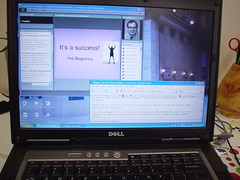
webinar 009
I am taking webinar notes directly into Blogger. Keeps me focussed!

First of all, the technology issues: What's an online seminar about technology with technology issues? I assume these were all on my end. I couldn't get the audio to work. I'd run the tech check last week and it showed up fine, but it was frustrating to catch the first few words of something and then it would drop for an uncertain amount of time. Luckily, there was also a call-in number. I had to dial it about 5 times before I got through (busy signal) so I bet I wasn't the only one with this issue.
webinar 005
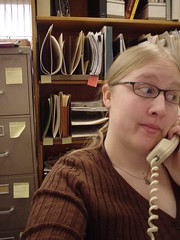
I've gotten through! And am making funny faces! Also, please to note my complex system of post-its.

And then I had troubles with Adobe Connect Professional, particularly with the polls the presenters could do: they didn't come up fast enough for me to participate in, alas. I imagine this has to do with my internet connection, even though my pre-webinar tech-check gave me the thumbs up. Heavy sigh.

Now that I've got the tech-whining out of my system, let me just say it was great. I really enjoyed this webinar. I don't have the resources to make it to MW2008, and this felt like a little piece of that: People who get technology talking about technology.

Two of the presenters talked about planning. One, Len Steinbach, focussed on Return on Investment Analysis. Angela Spinazze focussed on more general planning for technology. I enjoyed these presentations, because one of the things they focussed on was one of my harping points: know why you want to do things before you do them! Angela also brought up that it's okay not to implement technology. Yes. Not everything is for everyone.

The third presenter, Holley Witchey, spoke on morals and ethics - the little issues that we don't like to talk about because we tend to transgress them on occasion - as they relate to museum technology. All the presenters brought forth great ideas and gave the participants a lot to think about. I found it invigorating to be part of such interest about technology. I'm definitely looking forward to the rest of the sessions.

You can still register for the three upcoming sessions. I've put my (unintelligible) notes below the jump, for those interested.


Len Steinbach: Return on Investment

- Be sure to consider the direct costs, the indirect costs. How will you maintain your project? What is your perceived benefit? Take everything into account in your planning. This is return on investment analysis.

- What kind of return do you want? $$$ or mission? How do you evaluate mission based returns? How will you?

- Is there a champion in your institute? Who makes technology happen? And will there be momentum to maintain the change after the champion leaves? Make the plan to make it happen.

- Balancing multiple projects. Return on Investment will make your reasoning transparent. Provides a strong case and creates measurable expectations.

- The risk of too much success and the needs of staffing. How can small museums manage their success? engage in partnerships. buy external hosting with giant bandwidth. What is the worst case success scenario? What is the cost?

- Resources on best practices, ROI: the book, Len will post links to resource docs in forum. Management: part art, part science. No exact formula.

Angela Spinazze: Technology Planning

*grr! I'm having a bear of a time with the Adobe Seminar thing. I'm not getting the polls loaded, the slides, the presenters. Arg. It's so frustrating.*

Planning: Assess needs. define purpose, priorities, goals, objectives. Identify stakeholders. Set Timelines. Calculate costs. Manage Expectations. Evaluate Outcomes. (And now the adobe thing is working. but too late to participate in the polls.)

Assessing needs. Do it! observe, determine. What needs are you meeting?
Stakeholders: Anyone involved, anyone with an interest. Possible funders? Competing project people? Who are you up against?
Timelines: project, roll out, testing phase. Build in times. Testing!!
Costs: See Len's. Understand what your immediate costs, your contingency costs, your long term costs/maintenance costs.
Expectations: Do the needs assessment to find out what people's expectations are, and be able to address people's concerns as you go. Be prepared to explain if things go wrong.
Evaluate: Do it!! Learn from what you've done.

Planning process will take as long as it needs to take. Take it as seriously as you would an implementation phase. Resolve problems as they emerge, if you can.

Questions to consider: (things for needs assessment - the obvious of why we want/we need things and why?) How will it relate to/support/advance the mission? Cost (develop/maintain/UPGRADE)? Ease(resources?)? How will this effect other museum priorities and activities? Demand (from where? Is there any?)? How does it relate to branding? What is the rep/age of the technology(established?)? Transition Plan? Who needs to be on the project team?

Advice! Plan extensively (3-5 years!!!). talk with people, find resources, find other plans. Start small and build. Don't do it all at once (because you can't. no one can). You don't have to do it. Making mistakes leads to learning opportunities. Be creative, have fun.

What are you trying to do for whom?

Examples, inspirationary places: 59 smartest orgs online:http://www.squidoo.com/org20, http://www.tasi.ac.uk/, http://www.wethepeople.gov/projects/index.html, http://www.techsoup.com/

Planning for the future: Keep your eye outside the box. Keep your finger on the pulse of trends. Look outside the museum community (or community in which you work). http://www.boxesandarrows.com/

Retroplanning: Look at what you've made without planning and evaluate it and move forward. (ie old websites, dodgy online exhibits, etc.)

Holly Witchey: Morals and Ethics (you Kant make me)

*love any title with a pun in it*

Ethical issues in one place may be legal issues in another. Museums like to talk about BIG and IMPORTANT and GLAMOROUS issues. These are pretty easy to discuss because they're entertaining and generally involve other people.

What we don't like to talk about: Personal copies? Music on comp/networks? Copyright issues in powerpoint presentations? Borrowing tech? Personal browsing? THE SMALL ISSUES, institutional culture.

Everyday tech costs money too!

Solid vs. Chameleon Ethics. Fortune cookie: The fact that others are bad does not imply that you are good *what a depressing fortune cookie* How can we start conversations in places where values come into conflict? (Exhibition/preservation) Choices.

For a CoE to be valid: Involvement with production. Coherence with general principles and conscience. Coherence with company's officers behavior.

Guidelines for dealing with conflicts: articulate, analyze, personalize (look at your values), escalate (if needed).

Read More...

Wednesday, October 24, 2007

How to Study Museums

I just caught wind (via Musematic) of a new MA in Museum Studies offered by John Hopkins University. A new program is not surprising - museum programs and Museum Studies MAs seem to be proliferating like very slow academic bunnies. What is surprising is that the MA is almost entirely online except for an on-site summer seminar.

I have three reactions to this:

1. This MA recognizes that technology and the interwebs are important for museums. A classmate of mine conducted a survey and found that technology in museums is the least covered topic in museum programs nationally. So the recognition of that and the addressing of it is important.

2. How cool. An online MA for museum studies. I would totally love to take some of those courses, but am so not going to pay for that. But it's really appropriate to people in the field who may not be able to devote the kind of class time needed at a brick and mortar instition.

3. How the heck can you have a museum studies program outside of a museum? The most important thing to me, as a relative museum outsider to the museum field at the outset of my graduate work, was having that chance to live and breathe museums for two years. To gain significant practical experience while addressing museum theory. For me, it's unimaginable to have gotten my degree with such limited requirements for hands on.

I think it's very interesting. But I don't think it's the best degree for a young person out of undergrad to pursue. Every spring, the Museum-L listserv has an influx of graduates worrying about getting a job. And the advice is, inevitably, get hands on experience, get your foot in the door. Those are two things I find problematic with this degree. It's up to the student to develop those two opportunities. That was true at mine too, but there were clear doors. I worry that, if the student is a stay-at-home-mom with limited time to volunteer or be involved in the program, that she will have a difficult time actually putting her degree to work.

Nonetheless, I think it's an interesting idea, a good thing for people in certain places, and covers topics which are largely lacking in scholarly museum education.

Read More...

Tuesday, February 27, 2007

Tracing Active Learners

Constructivist theory figures largely into my rationalization of blogs for museums.

Today I realized that I don't know enough about it and am tracing it through Wikipedia. Gods bless Wikipedia for relatively accurate, extensive, and well linked information.

Jean Piaget, father of Cognitive Development

Cognitive development led, in part, to Constructivist Epistemology which tells us that there is no inherent reality, only that which is constructed by the mind and by society.

Then there's Lev Vygotsky who was instrumental in theories of social construction, in which an individual's construction of reality is influenced by their surroundings (ie society). He's also the Zone of Proximal Development guy. The Zone of Proximal Development being not a Star Trek episode, but rather the zone between what a learner knows and what they have the potential to know. It suggests that the ability to learn is affected by social interaction and collaboration.

Jurgen Habermas is also a name to know. His theory of the public sphere as "a network for communicating information and points of view" dovetails nicely to a discussion of blogging in museums, I think. "Democratic public life only thrives where institutions enable citizens to debate matters of public importance." Public realm accessible to all? Sounds like the internet to me. Well, accessible to many people in developed countries at least. If we were to get into less developed countries and issues of class we'd have a very different paper. An extremely important one, but different.

Moving out of Wikipedia, there's George Hein, author of "The Constructivist Museum" in which Hein explains why constructivism is what all the cool kids on the museum block should be doing. He has no Wikipedia entry.

And that's what I know. For today at least.

Look! Tribbles! Hmmm... that reminds me of an article I read, Be Constructive: Blogs, Podcasts, and Wikis as Constructivist Learning Tools, which used terribly mixed Star Trek metaphors and saying to try and facilitate the article. Good information, bad use of Star Trek.

Read More...