Showing posts with label communities. Show all posts

Tuesday, February 12, 2008

Digital Museum Webinar: Planning for Technology

When I heard about this webinar I was excited. Then disappointed. As someone fresh out of grad school, I don't have a lot of disposable income to put toward professional development, even very reasonably priced professional development. But, hark!, AAM's EMP (that's Emerging Museum Professionals, not electro-magnetic pulse or Experience Music Project) was offering a limited number of fellowships to EMPs. So I applied for one and was lucky enough to be selected. I just finished with the first Webinar, and it was pretty neat. Plus I received a copy of The Digital Museum: A Think Guide for being a participant.
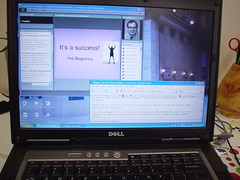
webinar 009
I am taking webinar notes directly into Blogger. Keeps me focussed!

First of all, the technology issues: What's an online seminar about technology with technology issues? I assume these were all on my end. I couldn't get the audio to work. I'd run the tech check last week and it showed up fine, but it was frustrating to catch the first few words of something and then it would drop for an uncertain amount of time. Luckily, there was also a call-in number. I had to dial it about 5 times before I got through (busy signal) so I bet I wasn't the only one with this issue.
webinar 005
I've gotten through! And am making funny faces! Also, please to note my complex system of post-its.

And then I had troubles with Adobe Connect Professional, particularly with the polls the presenters could do: they didn't come up fast enough for me to participate in, alas. I imagine this has to do with my internet connection, even though my pre-webinar tech-check gave me the thumbs up. Heavy sigh.

Now that I've got the tech-whining out of my system, let me just say it was great. I really enjoyed this webinar. I don't have the resources to make it to MW2008, and this felt like a little piece of that: People who get technology talking about technology.

Two of the presenters talked about planning. One, Len Steinbach, focussed on Return on Investment Analysis. Angela Spinazze focussed on more general planning for technology. I enjoyed these presentations, because one of the things they focussed on was one of my harping points: know why you want to do things before you do them! Angela also brought up that it's okay not to implement technology. Yes. Not everything is for everyone.

The third presenter, Holley Witchey, spoke on morals and ethics - the little issues that we don't like to talk about because we tend to transgress them on occasion - as they relate to museum technology. All the presenters brought forth great ideas and gave the participants a lot to think about. I found it invigorating to be part of such interest about technology. I'm definitely looking forward to the rest of the sessions.

You can still register for the three upcoming sessions. I've put my (unintelligible) notes below the jump, for those interested.


Len Steinbach: Return on Investment

- Be sure to consider the direct costs, the indirect costs. How will you maintain your project? What is your perceived benefit? Take everything into account in your planning. This is return on investment analysis.

- What kind of return do you want? $$$ or mission? How do you evaluate mission based returns? How will you?

- Is there a champion in your institute? Who makes technology happen? And will there be momentum to maintain the change after the champion leaves? Make the plan to make it happen.

- Balancing multiple projects. Return on Investment will make your reasoning transparent. Provides a strong case and creates measurable expectations.

- The risk of too much success and the needs of staffing. How can small museums manage their success? engage in partnerships. buy external hosting with giant bandwidth. What is the worst case success scenario? What is the cost?

- Resources on best practices, ROI: the book, Len will post links to resource docs in forum. Management: part art, part science. No exact formula.

Angela Spinazze: Technology Planning

*grr! I'm having a bear of a time with the Adobe Seminar thing. I'm not getting the polls loaded, the slides, the presenters. Arg. It's so frustrating.*

Planning: Assess needs. define purpose, priorities, goals, objectives. Identify stakeholders. Set Timelines. Calculate costs. Manage Expectations. Evaluate Outcomes. (And now the adobe thing is working. but too late to participate in the polls.)

Assessing needs. Do it! observe, determine. What needs are you meeting?
Stakeholders: Anyone involved, anyone with an interest. Possible funders? Competing project people? Who are you up against?
Timelines: project, roll out, testing phase. Build in times. Testing!!
Costs: See Len's. Understand what your immediate costs, your contingency costs, your long term costs/maintenance costs.
Expectations: Do the needs assessment to find out what people's expectations are, and be able to address people's concerns as you go. Be prepared to explain if things go wrong.
Evaluate: Do it!! Learn from what you've done.

Planning process will take as long as it needs to take. Take it as seriously as you would an implementation phase. Resolve problems as they emerge, if you can.

Questions to consider: (things for needs assessment - the obvious of why we want/we need things and why?) How will it relate to/support/advance the mission? Cost (develop/maintain/UPGRADE)? Ease(resources?)? How will this effect other museum priorities and activities? Demand (from where? Is there any?)? How does it relate to branding? What is the rep/age of the technology(established?)? Transition Plan? Who needs to be on the project team?

Advice! Plan extensively (3-5 years!!!). talk with people, find resources, find other plans. Start small and build. Don't do it all at once (because you can't. no one can). You don't have to do it. Making mistakes leads to learning opportunities. Be creative, have fun.

What are you trying to do for whom?

Examples, inspirationary places: 59 smartest orgs online:http://www.squidoo.com/org20, http://www.tasi.ac.uk/, http://www.wethepeople.gov/projects/index.html, http://www.techsoup.com/

Planning for the future: Keep your eye outside the box. Keep your finger on the pulse of trends. Look outside the museum community (or community in which you work). http://www.boxesandarrows.com/

Retroplanning: Look at what you've made without planning and evaluate it and move forward. (ie old websites, dodgy online exhibits, etc.)

Holly Witchey: Morals and Ethics (you Kant make me)

*love any title with a pun in it*

Ethical issues in one place may be legal issues in another. Museums like to talk about BIG and IMPORTANT and GLAMOROUS issues. These are pretty easy to discuss because they're entertaining and generally involve other people.

What we don't like to talk about: Personal copies? Music on comp/networks? Copyright issues in powerpoint presentations? Borrowing tech? Personal browsing? THE SMALL ISSUES, institutional culture.

Everyday tech costs money too!

Solid vs. Chameleon Ethics. Fortune cookie: The fact that others are bad does not imply that you are good *what a depressing fortune cookie* How can we start conversations in places where values come into conflict? (Exhibition/preservation) Choices.

For a CoE to be valid: Involvement with production. Coherence with general principles and conscience. Coherence with company's officers behavior.

Guidelines for dealing with conflicts: articulate, analyze, personalize (look at your values), escalate (if needed).

Read More...

Wednesday, November 07, 2007

Putting my money where my mouth is

As part of my job, I've been asked to think about the design of our website (which does not exist yet) and consider how more interactive possibilities might be incorporated. A link to my collections management blog, obviously, or if we could get it in the frames without leaving the main site would be better.

But what else? Podcasts are out (don't have the time, the tech, or the passion). Something where people can talk back, but not just a link to an email address. Full out forums are too big and too... well... dated (not that they don't work, but those are really designed for super committed special interest groups). Starting a Flickr account would be awesomely cool - and flickr has some widgets that look great on blogs and which could be interesting on a museum website. Twitter? Twitter seems cool and hip and all that, but is the user base really large enough that people would understand it and buy into it?

I think what I want is like "Guestbook 2.0" or a mini forum board. Where people can leave feedback and it shows up on the site immediately and can be responded to by museum personnel (ie, me), but requires little to no tech savvy from the end user, but doesn't look, er, lame. A guestbook with comment threading? Does such a thing exist?

And what else? Easy to use, easy to understand, and minimal work investment on our end. I know you're creative people reading this feed; let me pick your brains.

Edit: Gadunk! A Facebook group/profile! This IS a college campus after all. That whole guestbook 2.0? I want something like The Wall from Facebook to be on the site (except comment threading instead of wall-to-walls). Now where does one get such a thing....

Read More...

Wednesday, October 03, 2007

A beginner's guide to cool museum stuff online

I am really lucky. The folks involved in creating the museum at which I work are interested in the potential of new media for involving the community. But, they don't have as much exposure to the cool kinds of things museums are doing as, say, me! So a couple of weeks ago I put together this sort of "beginner's guide" for one of the professors with whom I work. And I thought I'd share. I think, if you read this, you probably know which applications and institutions I'm the most impressed with, but, hey, why not? :D

-------------------------

The Brooklyn Museum has a great all around approach to new media and community: CLICK

Australia's Powerhouse Museum is doing exciting things with their collections online, not just having them there, but allowing visitors to "tag" the online entries with keywords they find useful: CLICK

Eye Level, blog of the Smithsonian American Art Museum: CLICK

The Walker museum in Minneapolis has 6 blogs and are quite good. I especially like OffCenter and the New Media Initiatives blogs: CLICK

The Science Museum of Minnesota has a pretty cool area called Science Buzz with a blog that posts current science stories, polls, and offers registered users the chance to post at top level. There are also interactive kiosks inside the museum from which visitors can comment: CLICK

The Victoria and Albert has a section on knitting which incorporates their collection, but goes beyond it: CLICK The V&A also have a couple of artist blogs.

That's an overview of some of what's out there. The Powerhouse and Science Buzz are two of the most exciting things, in my opinion. Many museums are podcasting; many are creating facebook groups or profiles; some museums are venturing into Second Life; and some are playing with Twitter. Pretty much, any new application which catches on with a segment of the population, museums are starting to experiment with.

Leslie of MuseumBlogging.org had a pretty good series on museums and social networking sites: CLICK

Nina Simon of Museum 2.0 writes very thoughtful and thought provoking posts at her blog: CLICK

Two final things: If you want to look around at museum blogs, http://museumblogs.org/ has a list of 208 museum and museum-related blogs. And the sidebar of my thesis blog has about 100 museum blogs, not all of which are on museumblogs.org: http://museumblogthesis.blogspot.com/.

----------------------------

Whatcha think? What did I miss that's supah cool?

Oh! I got up the nerve to submit an abstract to MW2008. It's not really anything new, but I thought it might be an appropriate place to share my thesis research. If it did get accepted, I think I'd put up a new, modified survey to beef up that side of things. I won't be heartbroken if it doesn't make it in, but it'll be pretty nifty if it did. Anywho. I'm hoping to go either way.

Read More...

Friday, September 14, 2007

Reconsidering Second Life

In the last issue of Museum News there was that happy colorful exploration of Web 2.0. In this most recent issue, there's an article on museums in Second Life. I remain highly skeptical about Second Life. When I logged in sometime last year, I was frustrated by lag and texturing problems. Either my broadband or my year old laptop were unable to handle the requirements. I continue to feel the technological requirements of the environment make it a less than ideal space in which to reach a broad audience.

But I'm here to say something good about Second Life. Gasp! The article in Museum News - "My Raven-Haired Avatar Flies through the Museum" - had an example which made me pause. When the Exploratorium in San Francisco set up an internet broadcast of a solar eclipse along with a concurrent event in Second Life, they discovered something. Although many people visited the website to watch the webcast, they watched for an average of 7 minutes.

Those who came to the Second World event, about 60 to 70, stayed for the entire hour. They were engaged and asked questions.

This is the most compelling argument for Second Life I have yet heard. Quality of visitor interaction. Yet, I still wonder about the trade offs in terms of cost to develop and maintain an in-world space... But I'm open to being persuaded.

Read More...

Thursday, September 06, 2007

Brooklyn Strikes again!

Anyone who saw the session with the good folks from the Brooklyn Museum was pretty blown away by how, well, awesome they are. The Brooklyn Museum has a huge backing of community involvement and web forward thinking. And awesome Flickr use.

And now they have blogs! Have they been around a long time? Did I miss them?

Links!
feminist.bloggers@brooklynmuseum - Feminist art, news, and events from the Elizabeth A. Sackler Center for Feminist Art

and

bloggers@brooklynmuseum - a behind the scenes blog.

Both blogs have full text syndication. How I love full text syndication. I hate stubs, I hate clicking through, I really do.

Plus, and this is really cool, you too can be on the Brooklyn Museum's blogging community, if you ask nicely.

I look forward to seeing how these blogs read!

Read More...

Tuesday, August 28, 2007

Will you be my friend?

I've noted a lot of talk in the past months about the internet and the changing meaning of friendship. I haven't actually gotten to reading what people are writing, and once I do, I'll return with a follow up post.

But these are my raw thoughts in their usual semi-coherent form.

I started blogging because one of my friends was doing it, and he was doing it on a site which combines the internet-special idea of "friending" with independent blogging - Livejournal. So I signed up, identified him as my friend, and have, in the intervening four year, accumulated around 50 individual "LJ friends," some of whom I know in real life, some of whom I have since met, and some whom I have never met but am, nonetheless, good friends with.

And all these social network sites which revolve around the idea of friending - they are all incredibly popular. And even reading a blog on a regular basis offers the idea of intimacy, of getting to know someone a little bit.

But, I wonder, can museums be your friend? This is why that issue of voice is so crucial. If there's not a real person communicating about the museum in a genuine way, I think it's harder to gain that friend-like trust. Maybe I'm wrong. But I don't feel a strong connection to the museum blogs I read, not really. I feel a stronger connection to the museum-related blogs I read, where it feels more individual, more specific. And I assume myself to be representative of others, so this is how it must be, right?

It's something to think about though... if Web 2.0 is about social connection, social collaboration and interaction, how can an institution which might shift personality with each new director maintain a sense of the personal in a blog? Or should it? I'm just not sure.

Read More...

Tuesday, July 03, 2007

I agree

YES! Web 2.0 stuff is cool, but for crying out loud, be thoughtful. Know what you're doing, but, more importantly, know why you're doing it.

My thesis research showed that a lot of blogs were started because someone thought the museum ought to have one. In some of those cases that someone seemed to have a strong vision of what the blog would become - and those are usually pretty successful, noticed blogs. In others, the blog became a bit miscellaneous and may be on the road to failure unless someone can come up with a purpose, a reason for it.

Of course, reasons don't guarantee successfulness. I know of at least one museum with a well thought out blog that I don't entirely buy into as successful yet. Perhaps in time.

Just because it's fast and easy doesn't mean you should do it. Oh, you should do it, but have a purpose. And a community to connect to.

Read More...

Friday, June 22, 2007

To be or not to be?

What do you do with a thesis blog when you finish your thesis? (I got the official grad school email, by the way. I'll have my piece of paper in 3-4 months. You'll just have to take my word for it until then (unlike LeVar Burton or Lt. Jordi LaForge, whose word you don't have to take (I'm sorry, that was a particularly lame reference, even for me, queen of nerdery))

I'm not sure what to do with this place. I don't want to give it up, cause I like you guys. Even if I think I got called fat in Italian. I don't speak Italian. But what to do with it? How to stay relevant? I've got a few ideas:

1. Become a link style blog. Read museum blogs, pointing out stuff I think is cool. Pros: Not really being done. Cons: Dear gourdesses there are so many museum blogs! Plus I think it would lose some of my voice, which could be a pro if you hate this rambly thing I've got going.

2. Try and get academic with it. Make posts trying to be all analytical and insightful. Pros: People love this stuff. Cons: It's not me. Sure, I've been in school FOREVER, but I'm just not cut out to be analytical; I see too many sides to things.

3. Just keep on keeping on. Do what I want. Some links, a little analysis, maybe blog reviews. Pros: I like doing this. It's messy, it's fun, and there's variety. Cons: It's messy. I might be taken less seriously than blogs which are more formal, and I would like to be taken seriously.

Really, I think I'll end up going with option number 3. But what are your thoughts? What would you like to see here?

And one more thing: That title bar. Maybe I ought to change that a bit now. Options (after the colon is the subtitle bit)!
1. Im in ur museum blogz: Readin' and analyzin'
2. Im in ur museum blogz: Online Culture and Museums
3. Aw, I dunno. I really like that "Im in ur" thing despite the fact that it'll date this like nobody's business. Suggestions?

Read More...

Friday, April 27, 2007

Hamster Macros

I dig Google Analytics. I just get tickled pink by seeing how many hits I had each day and what Google searches bring up my site. Mostly it's "im in ur" searches, but it's often "rethinking museums" (which is happening next week by the way - the conference), and sometimes searches looking specifically for the blog, or for my name.

The thing about the searches is cool, because you can see what your audience wants. Apparently, they want hamster macros (another search hit of late). But, if I were an institution, I would be more critical about these tidbits of information. If you're a museum blog and you're not tracking search hits, you should be. Most of you are. But it's fun too! Mellow and profitable! (2 points to id that reference, comfypants excluded)

Search terms can also let you know what potential communities might be interested in making contacts. I could do a joint museum blog blog and hamster macro blog. It would be confusing and have a targeted audience of 2? 3? I think Perian is with me, but I don't know who else would be. I'm writing flakey, but you get the idea.

I think I need to go join the zombie horde and get on with my thesis revisions. BRAINS! BRAINS!

Read More...

Tuesday, April 17, 2007

No title today, sorry

# notes:

Looks like there's a new blog at the Smithsonian: Office of Exhibits Central. There was an announcement on the Livejournal museum communities. Looks like they've been posting for a while though. I suspect an Eye Level style model for posting and start up. It's the Smithsonian, after all.

-------

Connecting with Communities. That's what this is all about. And let's have a little case study of what happens when you do connect with a community.

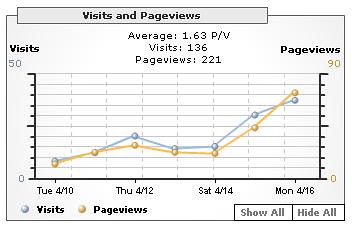
MBT - visits and pageviews

That's from my Google Analytics. In the past week I had a chance to connect with the museum and the web community. I handed out a few business cards (MOO cards rock!), put a few cards up on the jobs wanted board, and got mentioned in a couple presentations. And look what happened. An explosion. Normally I'm lucky to get about 8 direct hits to the blog. But almost 90? Wow.

I'm realistic. I may have grabbed a couple new readers, but most are probably poking their heads in. If my goal was to stay well connected with this community, I would get my URL out there more, go to more conferences, leave more comments on other blogs (as it is, I leave almost none *shameface*). But I'm pretty well wrapped up in my own little world right now. Maybe later, when I need to figure out where to go with this blog, maybe then I'll get active and try and get internet-famous.

-------

I think I've got a thesis title. Whaddya think of this?: "Constructing Connections: A Museological Approach to Blogging." It's a little more refined than "I'm in Ur Museum Website, Readin' and Analyzin' Ur Blogz" (bless its geeky little heart). The bit after the colon may be refined, but I think Constructing Connections gets at a few key concepts of blogs, so it's very plausible.

Read More...